Wednesday, October 30, 2013
Mysterious Planchette on Coast to Coast AM
Late tonight (or early tomorrow morning, depending on how you look at it), your curator Brandon Hodge will appear alongside his collaborator and Ouija board historian Robert Murch on Coast to Coast AM, hosted by George Noory, on their Contacting the Dead program. Show runs 1am-4am CST, and we'll be on for the full stretch, so please join us as we explore the bizarre world of spirit communication and the history of seances, talking boards, planchettes, and Ouija!
Monday, October 28, 2013
The Auburn Company's "Kyro" Unveiled!
The Auburn Company of Providence, Rhode Island has already gotten a fair assessment of its known history and products in my previous Wanda Tipping Table blog, given there due to the fact that for years collectors and researchers had assumed that their Syco-Graf was somehow related to Grover Haffner's creation due to the similarity of facial design. Unfortunately, that theory doesn't look to be playing out any more now than it did when I first revealed that info on the Auburn Company and its owners, and no new company information has come to light since that time. So it goes.
![]() |
| Various Syco-Grafs and ads for same, 1920s. |
Beyond the company info, we have surviving ads for the Syco-Graf, or, the "Micro-Psychic Machine," and the search for them had led us to ads for another of Auburn Company's creations, the aforementioned Kyro, the Psychic Writer.
| Kyro Psychic Writer advertisement, The Independent, March 1921 |
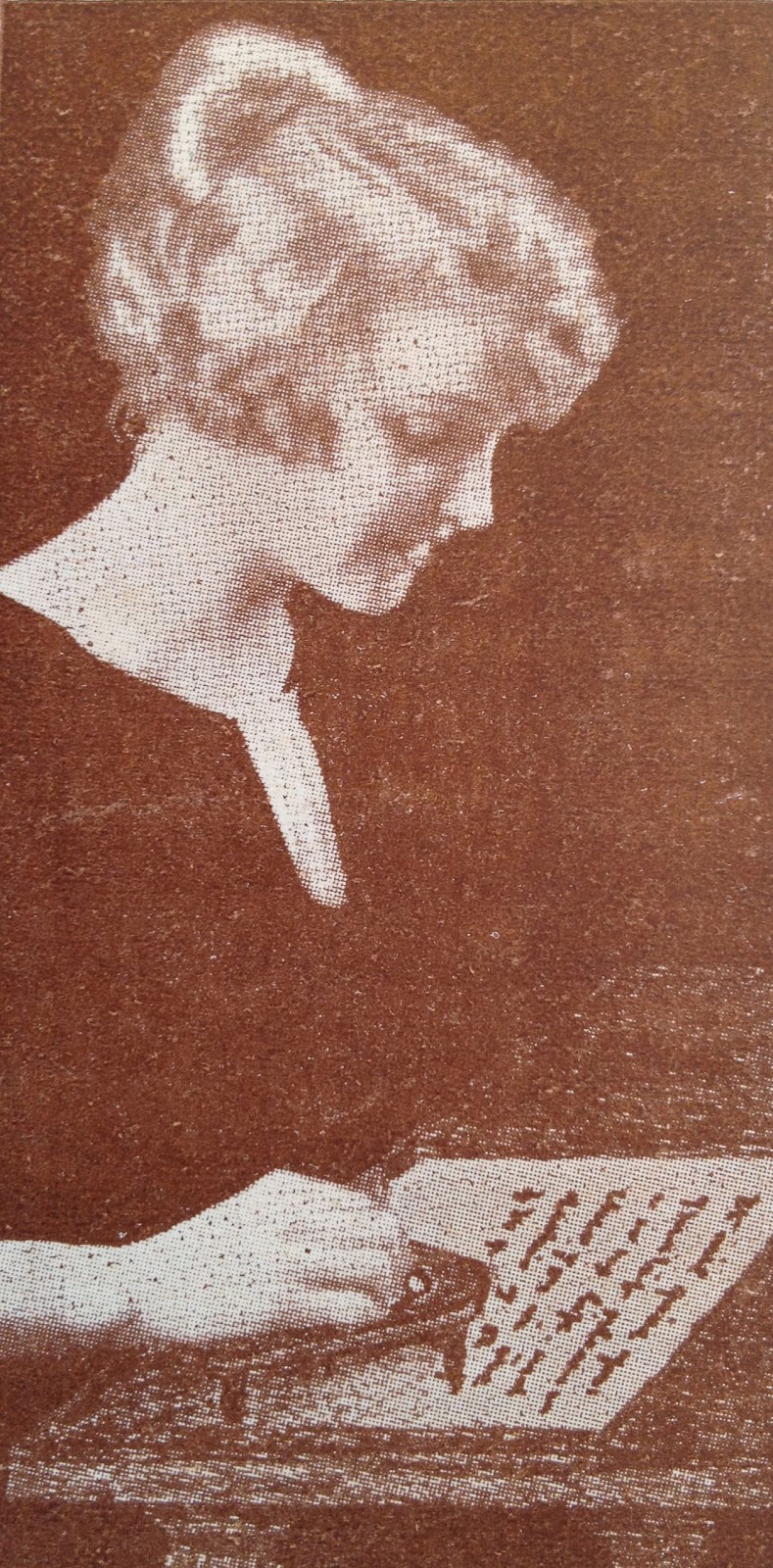
The pamphlet is a beautiful, petite little single-fold, expounding on the wonder of the Kyro psychic writer. We're blessed to finally, after this long search, to have a picture of the device, and in use, at that:
Operationally, the Kyro differs from other planchettes in that its aperture is centrally-placed, and "consists of a pencil and a special receptacle processed from silicated xylonite. The receptacle is covered by a thin diaphragm which connects with the pencil through a sensitive composition styled a "float," the same composition in effect as is now used on the latest model SYCO-GRAF." Xylonite is an early Bakelite-like celluloid substance, often used for knifes handle and imitation coral jewelry, so it seems we basically have a celluloid ring used as a retention for a thinner membrane in the window which holds the pencil, not unlike Fuld's classic clear-plastic-windowed planchettes from this period, only instead of holding a small needle as an indicator, the diaphragm is designed to hold the device's pencil. The illustration shows the planchette in use, and, sure enough, the young woman's hand is clasping the pencil, not the planchette's body--a possible clue into the potentially fragile nature of the celluloid diaphragm.
What is more mysterious is how this material is incorporated on the Syco-Graf, as the excerpt maintains. While the Syco-Graf in the Mysterious Planchette collection is admittedly missing its wooden indicator wheel, the remaining housing is brass, though it may be that the accompanying housing in the indicator itself was made of xylonite for "insulation" purposes, or the specimen I have wasn't the "latest" model incorporating this feature as the pamphlet hints.
![]() |
| Kyro detail. |
So, what are we looking for? The Kyro is a red mahogany-stained hexagonal plywood planchette, with some sections stained in a lighter "birch color," so it probably looks a lot like the woodwork of its larger sibling, the Syco-Graf. It is likely stamped with its name. It has bakelite-like legs that may or may not have tiny little wheels, and have the turned-wood appearance of early Ouija planchette legs. The aperture should have a retention ring of the same substance surrounding a celluloid film with a hole in the middle to hold a pencil. And, of course, somewhere on top is that essential faux-pearl.
Come to think of it, I'm pretty sure this thing couldn't be confused for anything else! So, eyes open, stalwart readers, and here's hoping that somewhere, a perfectly-preserved Kyro is lurking in a dark basement or attic, just waiting for its rediscovery.You just come whispering back to me...
Wednesday, October 23, 2013
The Sturmberg Planchette
![]() |
| Sturmberg Planchette illustration, from 1876's Life Beyond the Grave. |
"In myself I failed to develop the least trace of mediumship, either through table turning or planchette writing, until the summer of 1874, when I accidentally came in contact with an American medium who was reputed to have the power of developing mediumship in others. This person mesmerised my hand and arm—she never succeeded in mesmerising the brain— and the result was, that when I placed my hand on planchette I felt a dragging motion in the instrument, as if some invisible power were gently drawing it over the surface of the paper, uncontrolled by me."
Thankfully for most users, professional mesmerism of one's limbs was not a usual prerequisite for planchette use, but we're glad this medium--a student of the developing medium Mrs. Woodforde--found her way. Unfortunately, what begins as a ringing endorsement for the planchette is quickly abandoned, as the medium writes:
"I soon found the planchette was an impediment rather than an advantage to my progress as a writing medium, and that I could get on much more rapidly by simply holding the pencil in the hand and keeping the mind and the muscles of the arm perfectly passive."
But, planchette-scripted or not, the book's contents are not our subject--that would be the advertised 'little plank': the Sturmberg.
![]() |
| The full Life Beyond the Grave ad, 1876. |
![]() |
| Sturmberg Planchette Ad, The Medium & Daybreak, 1876. |
The planchette was available in 4 models: two full-size offerings in both high-grade finish and common grade, a "second size," and an intended-for-one-hand-use "small size." It had normal pantograph castors as was common for the planchettes of the period, and its closest relatives seems to be the Jaques & Son planchettes, or perhaps exceptionally similar Page & Co offerings, given its traditional blunt-nosed, flat-back design so indicative of British planks.
![]() |
| The likeliest contender: note routed outer ridge. |
![]() |
| 1895 Sturmberg solicitation. |
![]() |
| Sturmberg ad from 1886's The Philosophy of Mesmerism and Electrical Psychology. |
It is, in consequence of this foolish notion, that many persons give up communicating through planchette, on the assumption that it is diabolical; because, having asked foolish questions, they have induced foolish replies.
Indeed.
Wednesday, October 2, 2013
Boards of Future Past: The Downe Patent Device Discovered!
One of the great pastimes we collectors and researchers play amongst ourselves is the occasional overview of the patent record. There, we find all manner of incredible and inventive devices designed to communicate with the spirit world--most masterfully drawn--and often with tantalizing clues on those people behind their invention. What we're regrettably short on are the physical results of these patent applications, and as most remain elusive of the 'this-thing-was-actually-made-and-existed' category, and it is a rare satisfaction to be able to confirm the existence of a product from the patent record that we haven't previously identified.
But recently I was able to confirm the existence of the product that resulted from Patent #1,280,424--the Albert E. Downe patent from October 1, 1918. But that moniker is so dull and pedestrian compared to the name its makers eventually dubbed it: the "Ouija Snitch Baby!"
The discovery is new enough that we have very little information on the item. We know, of course, that Albert E. Downe of St. Paul, Minnesota patented the item, and, from its backplate, we know the Goldman-Linehan Manufacturing Company produced the device. Who devised its clever name, "Snitch Baby," and what Downe's association with this lost-to-google company is unknown, so any snitching we can do on the Snitch Baby's history will have to wait until we can charge headlong over the trenches of talking board research and battle the archives the old fashion way! But first, a brief pictorial overview of similar slide-dial devices, with the Snitch Baby nestled conveniently there in the middle (but note how the patent variation above fits so much cleaner in the evolution):
"Slide Dials" have been a popular form of spirit communication device since the Ouija's introduction, particularly since inventors sought to capitalize on the ebbing and flowing talking board crazes without running afoul of competitor's patents. The "Snitch Baby" falls squarely in the middle of their evolution. I hope you'll enjoy the pictorial overview of the beautiful device. The story behind its discovery is pretty interesting, and, as is so often the case, began with flip-phone-quality photos that brought to mind the famously-fuzzy Patterson-Gimlin footage, but that's a tale for another day...
The Snitch Baby is bigger than it looks. At nearly 2-feet long and about 4-inches wide, it is a substantial communication device. Its indicator is fixed, but its rolling carriage is built with enough play to lilt toward one side or the other, indicating either individual letters on the slide's right-hand side, or days of the week, numbers, months, or punctuation to the left and middle.
The indicator includes the patent date, confirming its identity with the Downe patent. It also includes the "New and Improved" tagline, which opens up the intriguing possibility that this is a later version. Note that the patent drawing includes a horizontal version of the board more akin to the UK Braham Telepathic Spirit Communicator and its variants. Could it be that the other drawing represents an older model?
The undercarriage contains Snitch Baby's instructions, and the identity of its maker: Goldman-Linehan Manufacturing Company of St. Paul, Minnesota. In a rare turn, it gives the Snitch Baby a definitively feminine sexuality, and the revelation that "Snitch Baby will also stand plenty of talking to, and will bring up any other guide you ask her for if such be possible" is an interesting reference to spirit guides for a device marketed at a time when so many companies preferred to leave such items' seance-invoking qualities ambiguous in order to market to a wider audience.
So, our watchful sentinel continues for the discovery of more devices that we wake every morning hoping will manifest on the record. Some we chase through the depths of time, and others elude our grasp like insubstantial time-shifting mutants sent to the present to warn us. Wait. What?*
But recently I was able to confirm the existence of the product that resulted from Patent #1,280,424--the Albert E. Downe patent from October 1, 1918. But that moniker is so dull and pedestrian compared to the name its makers eventually dubbed it: the "Ouija Snitch Baby!"
| Downe's 1918 "Game Device" Patent |
"Slide Dials" have been a popular form of spirit communication device since the Ouija's introduction, particularly since inventors sought to capitalize on the ebbing and flowing talking board crazes without running afoul of competitor's patents. The "Snitch Baby" falls squarely in the middle of their evolution. I hope you'll enjoy the pictorial overview of the beautiful device. The story behind its discovery is pretty interesting, and, as is so often the case, began with flip-phone-quality photos that brought to mind the famously-fuzzy Patterson-Gimlin footage, but that's a tale for another day...
The Snitch Baby is bigger than it looks. At nearly 2-feet long and about 4-inches wide, it is a substantial communication device. Its indicator is fixed, but its rolling carriage is built with enough play to lilt toward one side or the other, indicating either individual letters on the slide's right-hand side, or days of the week, numbers, months, or punctuation to the left and middle.
The indicator includes the patent date, confirming its identity with the Downe patent. It also includes the "New and Improved" tagline, which opens up the intriguing possibility that this is a later version. Note that the patent drawing includes a horizontal version of the board more akin to the UK Braham Telepathic Spirit Communicator and its variants. Could it be that the other drawing represents an older model?
The undercarriage contains Snitch Baby's instructions, and the identity of its maker: Goldman-Linehan Manufacturing Company of St. Paul, Minnesota. In a rare turn, it gives the Snitch Baby a definitively feminine sexuality, and the revelation that "Snitch Baby will also stand plenty of talking to, and will bring up any other guide you ask her for if such be possible" is an interesting reference to spirit guides for a device marketed at a time when so many companies preferred to leave such items' seance-invoking qualities ambiguous in order to market to a wider audience.
So, our watchful sentinel continues for the discovery of more devices that we wake every morning hoping will manifest on the record. Some we chase through the depths of time, and others elude our grasp like insubstantial time-shifting mutants sent to the present to warn us. Wait. What?*
*Bonus points for those who get the X-Men graphic reference and can name the issue and storyline.
Thursday, September 19, 2013
Board to be Yld: Wilder's "Mystic Hand" Discovered!
There's a two-way street at the intersection of Researchtown and Collectingville. One lane is bumper-to-bumper traffic, where we have new talking board discoveries driving searches for period print ads to confirm dates and locations. We just need the reappearance of a physical specimen to drive the research. The other lane, though, is a seldom-traveled freeway dotted with the stalled vehicles of old print ads of as-yet undiscovered items, endlessly enticing collectors to just go out and find these things. In some cases, like the Baltimore Manufacturing Company's "Spirit Finger," we're reading a billboard that's nothing more than a false lead to a device that's decidedly *not* a talking board as we'd hoped. In other cases, though...
A chance eBay discovery years ago led me to a fantastic and promising print ad on the back of a 10-cent "Gypsy Fortune Teller and Dream Book" from the late 1910s. There, fully illustrated, was a definitive automatic writer: The Mystic Hand! Just as the ad proclaimed, the discovery was "truly wonderful." Of course, I always love it when a company embraces a device's spirit communication ambitions, instead of trying to conceal them in the vernacular of games, and the manufacturer even gave a nod to the early history of seances, so I was excited!
The ad didn't provide the specific clue, but the Mystic Hand was not entirely a surprise. Wilder Manufacturing Company produced a Mystic Hand planchette as the stock indicator for their line of Mitche Manitou talking boards. But this was just an indicator conspicuously absent of a pencil, and not an automatic writer. But a Mystic Hand writing planchette? Well, that was an incredible and enticing find! And, experience tells us, you rarely see advertisements for items that never made it to market, so I knew that out there, somewhere, was a tattered and torn Mystic Hand with a sharpened pencil where a front leg was supposed to be. Or, you know, one new in the box. A boy can dream, can't he?
Imagine how my heart jumped early one morning when this Wilder "Mystic Writing" set appeared on eBay, and with a pretty reasonable (and, most importantly, unclaimed) Buy It Now. From that first thumbnail, I thought with a single click I'd be taking a hard left off of Ad Avenue and racing toward Collectingville. But a few more clicks revealed a mis-read map, and it turned out that the Mystic Writing set was more of a fortune-telling device than a piece of spirit communication apparatus. Despite the beautiful litho in the box top, my disappointment was manifest, and I let my good friend and collaborator Bob Murch--riding shotgun on the other end of the phone--nab it instead, with him all the while promising me that "Brandon, you're going to want this, so when you do I've got it." He was right. I eventually came around, had to have it, and it's resting here now mocking me that I owe Bob big for something in return. Thanks, Murch!
(The Mystic Writing set is actually an amazing find worthy of its own blog post--you scribble your name on the central pad, and the pressure of the pencil pushes a lever that drives the indicator around, arriving on your fortune. Ingenious little game!)
It is hard not to get disheartened at the false hope and tugged-on heartstrings. As collectors, we stash the knowledge of these promising ads deep in our skulls, where they sit for just the right moment--that certain flash of recognition--to jump front and foremost in our minds again. Of course, once you drag those covetous thoughts back out again, they become hard to put away, and you can't even browse an antique shop without thinking every vintage ashtray and bookend is a glimpse of your hallowed prize.
Luckily, I didn't have to suffer that indignity long. Weeks later, my inbox had an intriguing message: "Saw you needed a mystic hand. I have one." Sometimes, when you put something like that out into the world, it becomes a beacon. It retail we call it "putting your mojo" on something, a concept Mike Zohn of Obscura Antiques & Oddities recently discussed at a Parafest panel: you can have a piece of merchandise lay fallow in your shop for years, but the minute someone shows interest in it, everyone suddenly realizes it's there. It just happens that way.
So, with a few emails back and forth and a fair price negotiated, the long saga to confirm the existence of Wilder's Mystic Hand Writing Planchette came to an end. It exists. They made it. And it is both beautiful and glorious, and one of the most finely-lithographed boxes in the planchette trade. An interesting observation was the previously unknown "YLDER" trademark you can see in the lower left--a clever sidestep to score a trademark for "Wilder" that someone else undoubtedly already held.
The planchette itself is the exact same dimensions as the talking board indicator, which makes it a either a fantastic cross-promotional product making use of the same template to double-dip into the public's pocketbook, or a clever attempt to recycle leftover or excess stock of talking board pointers. Or neither. Or both. Either way, it is a fantastic find, and a really fantastic addition to my collection. I know you'll enjoy checking it out!
![]() |
| The Mystic Hand ad that started the hunt! (Cover shown in inset) |
![]() |
| Wilder's "Mitche Manitou" talking board, 1910s-1920s, with Mystic Hand indicator, shown. Courtesy Vespia Collection. |
The ad didn't provide the specific clue, but the Mystic Hand was not entirely a surprise. Wilder Manufacturing Company produced a Mystic Hand planchette as the stock indicator for their line of Mitche Manitou talking boards. But this was just an indicator conspicuously absent of a pencil, and not an automatic writer. But a Mystic Hand writing planchette? Well, that was an incredible and enticing find! And, experience tells us, you rarely see advertisements for items that never made it to market, so I knew that out there, somewhere, was a tattered and torn Mystic Hand with a sharpened pencil where a front leg was supposed to be. Or, you know, one new in the box. A boy can dream, can't he?
![]() |
| False starts and racing hearts: the Wilder Mystic Writing game. Beautiful, no doubt, but not an automatic writer. |
Imagine how my heart jumped early one morning when this Wilder "Mystic Writing" set appeared on eBay, and with a pretty reasonable (and, most importantly, unclaimed) Buy It Now. From that first thumbnail, I thought with a single click I'd be taking a hard left off of Ad Avenue and racing toward Collectingville. But a few more clicks revealed a mis-read map, and it turned out that the Mystic Writing set was more of a fortune-telling device than a piece of spirit communication apparatus. Despite the beautiful litho in the box top, my disappointment was manifest, and I let my good friend and collaborator Bob Murch--riding shotgun on the other end of the phone--nab it instead, with him all the while promising me that "Brandon, you're going to want this, so when you do I've got it." He was right. I eventually came around, had to have it, and it's resting here now mocking me that I owe Bob big for something in return. Thanks, Murch!
(The Mystic Writing set is actually an amazing find worthy of its own blog post--you scribble your name on the central pad, and the pressure of the pencil pushes a lever that drives the indicator around, arriving on your fortune. Ingenious little game!)
![]() |
| The man, the myth, the fullback: Allen B. Wilder, maker of the featured items. |
It is hard not to get disheartened at the false hope and tugged-on heartstrings. As collectors, we stash the knowledge of these promising ads deep in our skulls, where they sit for just the right moment--that certain flash of recognition--to jump front and foremost in our minds again. Of course, once you drag those covetous thoughts back out again, they become hard to put away, and you can't even browse an antique shop without thinking every vintage ashtray and bookend is a glimpse of your hallowed prize.
![]() |
| It DOES exist! Wilder's Mystic Hand manifests in my inbox! |
Luckily, I didn't have to suffer that indignity long. Weeks later, my inbox had an intriguing message: "Saw you needed a mystic hand. I have one." Sometimes, when you put something like that out into the world, it becomes a beacon. It retail we call it "putting your mojo" on something, a concept Mike Zohn of Obscura Antiques & Oddities recently discussed at a Parafest panel: you can have a piece of merchandise lay fallow in your shop for years, but the minute someone shows interest in it, everyone suddenly realizes it's there. It just happens that way.
![]() |
| Box detail: among the most beautiful planchette packages ever produced. |
So, with a few emails back and forth and a fair price negotiated, the long saga to confirm the existence of Wilder's Mystic Hand Writing Planchette came to an end. It exists. They made it. And it is both beautiful and glorious, and one of the most finely-lithographed boxes in the planchette trade. An interesting observation was the previously unknown "YLDER" trademark you can see in the lower left--a clever sidestep to score a trademark for "Wilder" that someone else undoubtedly already held.
![]() |
| Topside and Bottom: the planchette puts a pencil where the leg should be! |
The planchette itself is the exact same dimensions as the talking board indicator, which makes it a either a fantastic cross-promotional product making use of the same template to double-dip into the public's pocketbook, or a clever attempt to recycle leftover or excess stock of talking board pointers. Or neither. Or both. Either way, it is a fantastic find, and a really fantastic addition to my collection. I know you'll enjoy checking it out!
![]() |
| Oh, Miley! NONONO!!! (Thanks, Mr. Rinker) |
Tuesday, August 20, 2013
The Nicholl-Higginson Planchette
In my realm of collecting, it is incredibly rare to acquire items with any sort of significant provenance. Talking boards seem to come along with disclaimers of "this was my grandfather's board" far more often than planchettes, and given that there's a 2-generation gap between the initial popular peaks of the devices, and that planchettes faded into obscurity after their very-last-gasp in the 1930s, that should come as little surprise. And while my peers in the talking board world are often able to locate surviving family members with some recollection of their forebears' manufacturing activities, equivalent discoveries for an industry stretching back many decades further into the 1860s proves exceptionally problematic--there's just too much time and distance between the people and events--and the memories died with those who carried them a generation or two before I arrived to archive them.
But not all is lost. This past June, I managed to acquire a very special piece--one of a fantastic set of planchettes--with verifiable provenance, a rich family connection, and ties to Spiritualism in the UKand famous mediums of the pre-and-post-WWII period. And I must thank series regular Glenn Rinker for his recent astute observations that jarred me to the historical potential of this item after I'd shelved away the keywords for future follow-up. Thank you, Mr. Weatherman!
When Mr. Nicholl-Morris first contacted me about the purchase of his family's planchette, there was no initial cause for excitement beyond that which a collector feels when they first see a new discovery. Exuberance, yes, but not the awe and reverence that comes with a provenanced item. In fact, it wasn't anything Mr. Nicholl-Morris felt obliged to pitch as part of the purchase, beyond the hints that the planchette had been in his family for some years.
In fact, my initial assessment of the planchette was that it was most likely handmade, though possibly a manufactured item, but if it was a production piece, I guessed from afar, the original castors had long been replaced with the sturdier and bulkier ball-bearing castors more commonly found in the furniture trade. If that were the case, I predicted the original castor holes would be visible beneath the newer encasements, and I'd be able to confirm if it was a production or homemade piece. Given the classic shape and seemingly-exquisite construction, my opinion was split.
And that remained, at least initially, the biggest question the planchette posed, and I otherwise acquired it with my usual zeal and gratitude to Mr. Nicholl-Morris.
When the planchette arrived from overseas, it contained a few surprises. Not the least of which was the discovered absence of other hardware marks or holes from previous castors hidden beneath the oversized ball-bearing housings, whose retention screws just barely protruded through the top-piece where they were cut or filed down. In other words, this was most likely a handmade item, and not a manufactured piece. But with the exception of the near-overlong screws, it was lovingly constructed--perhaps professionally so--with the bulky hardware seemingly betraying it as such.
But the box contained another surprise: the personal recollections of Mr. Nicholls-Morris and the history of the planchette, lovingly scripted in a 4-page letter. It recounts a fair bit of family history centered on his grandmother, Mrs. Lois May Nicholl (nee Dixon, b. 1877) who passed away at the grand old age of 81 in 1959. Mrs. Nicholl was a "life-long enthusiast" of Spiritualism, spirit communication, and psychic phenomena--a quality she implanted in her grandson, who remains a member of the British Society for Psychical Research. Mr. Nicholl-Morris's letter recounted how he recalled that the planchette had been in his family from at least 1942, and that he clearly remembered his grandmother "getting messages off it, but my mother, another, and brother mainly obtained only scrawl!"
Accounts of a planchette specimen's use are rare enough, but the letter contained other intriguing details of the item's history and Mrs. Nicholl's spiritualist involvements. The seance circle attended by Lois May was one hosted by famed trance medium Fanny Higginson at London, Stock-on-Trent, in the area of Staffordshire known as the "Potteries" for its established ceramics industry. Fanny Higginson is, of course, the mother and mentor of famous British medium Gordon Higginson, and a famous medium in her own right, so well-known for her accuracy that a large British mining company would not dig test bore holes without her consultation. Fanny was inspired to mediumship as a teenager when she attended a seance held by Annie Brittain at Longton Church, who insisted despite Fanny's protests that the young girl's still-living mother's spirit was there with them; Fanny returned home with her Aunt to discover the medium was right after all, and that her mother had died while she was away. This event (and the medium's prediction that both Fanny and her future son would lead the church into a new era of spiritual communion) sparked not only a lifetime of devotion to Spiritualism and mediumship, but also a strict relationship in the upbringing of her son, Gordon Higginson, who's ascent would eclipse that of his mother's and who would eventually assume the role of President of the very church whose visit inspired his mother toward mediumship.
It is in this context that Lois May Nicholl displayed her automatic writing talents. Her grandson recounts her enthusiastic involvement throughout the 1930s and '40s, until her participation was cut short in 1945 with the family's move to North Wales. While she remained in Staffordshire, it is said she "received messages at Mrs. Higginson's circle to pass on to relative of military personnel who had lost their lives--sometimes carrying resentment!" And there, in her hands to receive these messages, was this planchette. And for all these years since her passing, her grandson has kept the device, before seeking a good home for his family's history and heritage in the mysteriousplanchette.com vaults. And we are thrilled and honored to be able to provide that assistance and share his memories of this enigmatic device that has such close ties to Spiritualism in the UK! As our research into the life of Lois May Nicholl continues, so too will her unfolding story.
As a side note to our arrangement, Mr. Nicholl-Morris immediately offered another planchette--this one belonging to he and his wife, and purchased some 15 years prior when he temporarily misplaced his grandmother's planchette and was in need of an automatic writer. It, too, is a fine specimen, and this time immediately identifiable as a Two Worlds Ball-Bearing Planchette, offered by the eponymous magazine in the 1930s onward. They are among the finest planchettes ever constructed or offered by any firm, with smooth-rolling ball-bearings and as thin and fine of construction as one might hope--and likely manufactured by the scientific-instrument makers Weyers Brothers. I am proud to display the pieces in tandem, and leave the leaves of history here so that the contributions of the Nicholl family to the research and dialogie of spirit communication devices, automatic writing, and Spiritualism will be remembered as long as I'm able to carry the torch.
But not all is lost. This past June, I managed to acquire a very special piece--one of a fantastic set of planchettes--with verifiable provenance, a rich family connection, and ties to Spiritualism in the UKand famous mediums of the pre-and-post-WWII period. And I must thank series regular Glenn Rinker for his recent astute observations that jarred me to the historical potential of this item after I'd shelved away the keywords for future follow-up. Thank you, Mr. Weatherman!
![]() |
| The Nicholl-Higginson planchette as solicited, its assigned name preserving both its family and Spiritualist associations. |
In fact, my initial assessment of the planchette was that it was most likely handmade, though possibly a manufactured item, but if it was a production piece, I guessed from afar, the original castors had long been replaced with the sturdier and bulkier ball-bearing castors more commonly found in the furniture trade. If that were the case, I predicted the original castor holes would be visible beneath the newer encasements, and I'd be able to confirm if it was a production or homemade piece. Given the classic shape and seemingly-exquisite construction, my opinion was split.
And that remained, at least initially, the biggest question the planchette posed, and I otherwise acquired it with my usual zeal and gratitude to Mr. Nicholl-Morris.
| The Nicholl-Higginson planchette on arrival, with Mr. Nicholl-Morris' letter behind. |
But the box contained another surprise: the personal recollections of Mr. Nicholls-Morris and the history of the planchette, lovingly scripted in a 4-page letter. It recounts a fair bit of family history centered on his grandmother, Mrs. Lois May Nicholl (nee Dixon, b. 1877) who passed away at the grand old age of 81 in 1959. Mrs. Nicholl was a "life-long enthusiast" of Spiritualism, spirit communication, and psychic phenomena--a quality she implanted in her grandson, who remains a member of the British Society for Psychical Research. Mr. Nicholl-Morris's letter recounted how he recalled that the planchette had been in his family from at least 1942, and that he clearly remembered his grandmother "getting messages off it, but my mother, another, and brother mainly obtained only scrawl!"
Accounts of a planchette specimen's use are rare enough, but the letter contained other intriguing details of the item's history and Mrs. Nicholl's spiritualist involvements. The seance circle attended by Lois May was one hosted by famed trance medium Fanny Higginson at London, Stock-on-Trent, in the area of Staffordshire known as the "Potteries" for its established ceramics industry. Fanny Higginson is, of course, the mother and mentor of famous British medium Gordon Higginson, and a famous medium in her own right, so well-known for her accuracy that a large British mining company would not dig test bore holes without her consultation. Fanny was inspired to mediumship as a teenager when she attended a seance held by Annie Brittain at Longton Church, who insisted despite Fanny's protests that the young girl's still-living mother's spirit was there with them; Fanny returned home with her Aunt to discover the medium was right after all, and that her mother had died while she was away. This event (and the medium's prediction that both Fanny and her future son would lead the church into a new era of spiritual communion) sparked not only a lifetime of devotion to Spiritualism and mediumship, but also a strict relationship in the upbringing of her son, Gordon Higginson, who's ascent would eclipse that of his mother's and who would eventually assume the role of President of the very church whose visit inspired his mother toward mediumship.
![]() |
| The trance medium Fanny Higginson |
![]() |
| Gordon Higginson manifesting ectoplasm. |
It is in this context that Lois May Nicholl displayed her automatic writing talents. Her grandson recounts her enthusiastic involvement throughout the 1930s and '40s, until her participation was cut short in 1945 with the family's move to North Wales. While she remained in Staffordshire, it is said she "received messages at Mrs. Higginson's circle to pass on to relative of military personnel who had lost their lives--sometimes carrying resentment!" And there, in her hands to receive these messages, was this planchette. And for all these years since her passing, her grandson has kept the device, before seeking a good home for his family's history and heritage in the mysteriousplanchette.com vaults. And we are thrilled and honored to be able to provide that assistance and share his memories of this enigmatic device that has such close ties to Spiritualism in the UK! As our research into the life of Lois May Nicholl continues, so too will her unfolding story.
| The Nicholl-Morris Planchette on display. |
![]() |
| Two Worlds Planchette Ad, 1938. |
Friday, July 12, 2013
Antediluvian Automatism: Ignatius Donnelly & the Dempsey Speaking Dial
"Go! from the speaking dial learn/
A lesson all divine/
From faults that wound your fancy turn/
And mark the hours that shine."
From faults that wound your fancy turn/
"I Mark the Hours that Shine"--Sophia H. Oliver
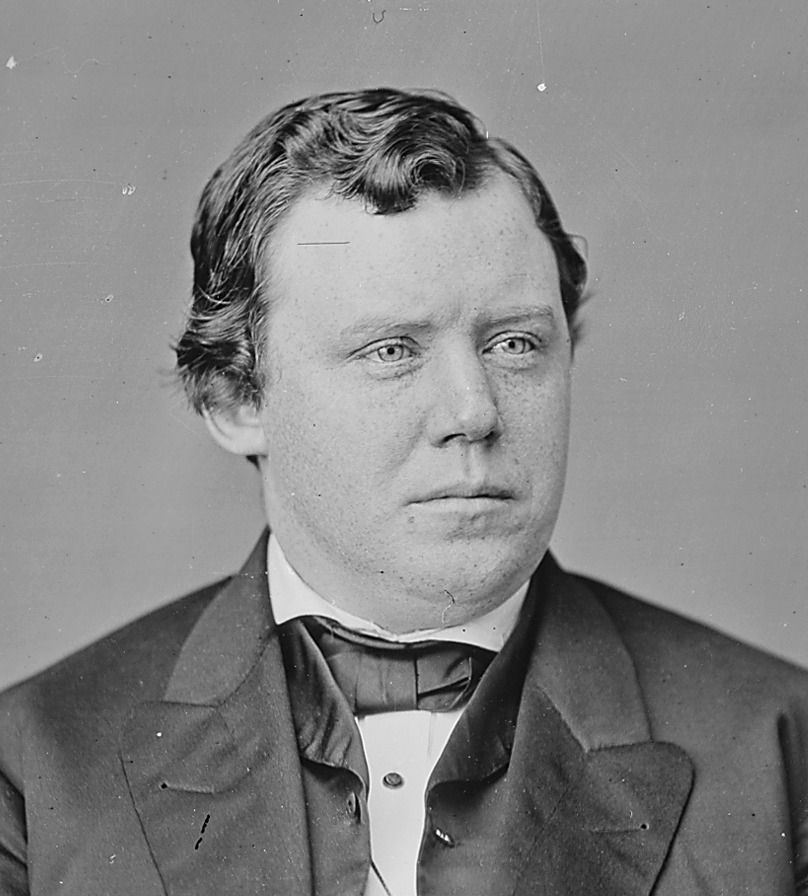
I don't normally cross the streams of my various interests here on the MysteriousPlanchette blog, but today's an exception. I recently returned from my publisher's annual convention, and encountered quite the talking board revelation while there. For those who don't know, I write adventures for the Pathfinder Roleplaying Game by Paizo Publishing. I've long drawn on our real-world esotericism and occult topics for my subject matter, such as Edward Bulwer-Lytton's concepts of "vril" and Ignatius Donnelly's lost-Atlantis theories, inspirations of which appeared in my previous works Sunken Empires and From Shore to Sea. My most recent adventure for Paizo, Rasputin Must Die!, actually pits the players against the historical Rasputin set against the backdrop of 1918 Russia in the throes of revolution--quite a departure from the typical swords-and-wizards fantasy tropes. The book also contained no insignificant amount of rules and essays on the occult in Russia during the period, and it was this subject that caught the eye of one of my editors, Christopher Paul Carey, who, as it turns out, is an Ignatius Donnelly scholar. And he just so happened to have previously stumbled across an amazing revelation not only on the antediluvian theorist's spirit-communication activities, but also added a new talking board to the investigative vaults. Needless to say, we spent the whole weekend riffing on our various disciplines while we had the chance to do so in person, and I can't thank my friend enough for sharing!
| Ignatius Donnelly (1831-1901), Antediluvian Theorist |
![]() |
| St. Paul Daily Globe, July 13, 1895. |
P.J. Dempsey was the patriarch of a large family in St. Paul, Minnesota, an avid Spiritualist, and inventor of the "Speaking Dial." The first recorded appearance of his unique talking table design arrived just one week prior to an important Spiritualist camp occurring near Lake Como, Minnesota, the week of July 13, 1895--important due to the featured appearance of famed trance medium Cora Richmond. The paper proclaimed the dial would "be in operation each day until the end of the month" at the camp, and, according to the accounts, the 12-hour exhibitions caused "something of a sensation" at these public appearances. Another interesting account hints that the Speaking Dial had been exhibited the year before by Dempsey at the state Capitol during previous Legislature in April of that same year:
![]() | |
| St. Paul Daily Globe, June 09, 1895 |
![]() |
| Assorted Speak Dial advertisements, St. Paul Daily Globe, 1895-1896 |
Luckily, we don't have to rely on unillustrated advertisements alone to determine the exact nature of the Speaking Dial's appearance and operation. Again, Chris has already done the discovery for us during the course of his Ignatius Donnelly research and, again, the Minnesota Historical Society, from whom he acquired the Donnelly journals, holds a revealing artifact among their archives. It is very likely a photograph of P.J. Dempsey's family, if the possibly-misspelled "G.W Dempsie" letterhead is any indication of a family relation in the Minneapolis photography studio business. Whatever the relation, a Speaking Dial is pictured in all of its glory.
![]() |
| Photo courtesy Minnesota Historical Society |
Unless the Dempsey family was particularly diminutive, the Speaking Dial would be one of the largest dial plate devices on record. In imagining its operation, my first hunch was that it was suspiciously similar to the 1922 Swallow patent:
"Spirit Wheel" by William H. Swallow, #1,418,686, June 6, 1922
|
| Ignatius Donnelly in 1898, one year prior to his first recorded exposure to the Speaking Dial. |
On August 12, Donnelly records another visit with Ms. Dempsey, where he reportedly received communications from his brother, John, and his mother and deceased grandson. The communications are full of typically inspirational and encouraging words from departed family members, including his first wife, who offers a positive endorsement of his second and still living wife. It is curious that once the more obvious member's of Donnelly's immediate family and their fates are run through, a curious blockade manifests. With Donnelly and Marie Dempsey working the board cooperatively, there comes a message from Donnelly's mother that "many dear ones whose names are in memory" are present. But, when pressed to name other departed friends and family whose spirits are said to be in attendance, the board falls silent, leaving the question open of whether Ms. Dempsey--perhaps in an attempt to impress the former lieutenant governor and congressman--might have been guiding the indicator during their session to provide some impressive and easily-researched answers, only to find herself at a loss when pressed for more details. Donnelly himself notes that he was prepared to quiz the board, but wasn't given the chance. It is unknown if his own suspicions were aroused to Marie's possible implications in the board's dishonesties.
By his own account on January 12, 1900--less than a year before his death--Donnelly returns to the Speaking Dial "for the first time in many months "to commune with the unknown force that manifest itself through it." His questions are general, and typically focus on inquiries to book sales and reviews, with responses predicting a favorable on in England's Pall Mall Gazette. Other typical communiques of the times follow, with predictions of storms, the outcome of the Boer War, and even a prediction of Donnelly's own election as US President in 1904! Donnelly is impressed, but not convinced, remarking "I do not, of course, attach any confidence in these prophecies, but there is an intelligence here separate and apart from our own, and it is wortwhile to try to find out its characteristics and limitations."
It is curious to note in the next day's entry, January 13, Donnelly notes that they are visited by a Stanley Twitchell, who himself is mentioned as having purchased his own Speaking Dial before coming to Donnelly to learn how to operate it, and it seems Ignatius made be a bigger proponent of the device than he truly lets on. But his entries and inquiries constantly test the board's intelligence and answers, and he seems to be constantly attempting to trap the spirits in some contradiction.
![]() |
| The Speaking Dial in its natural environment. |
But it is Donnelly's February 20, 1900 entry that finally reveals and appears to confirm the board's mechanism--a mechanism hearkening back to the earliest days of spirit communication devices. That night, while he is apparently still living at Minneapolis' Hotel Waverly, Mr. Dempsey himself, accompanied by his daughter, Marie, visited Ignatius and his wife. With them, they carried a new Speaking Dial as a gift, which they claimed Dempsey's spirit "control" had advised them to construct and deliver to the author, since they had heard his old one was worn from use. The next sentence that proceeds a lengthy correspondence with a former rival politician (and an incredibly humorous aside as Donnelly references his January 13 entry to prove the dial was incorrect in its Pall Mall Gazette predictions!) gives us a vital clue to the Speaking Dial:
"He fastened it upon the little table, and Marion and Marie proceeded to operate it."
What is so important in this entry is the inclusion of a table in the dial's operating mechanism. This, together with the earlier clue from the following advertisement, indicates that the board did not operate independently like most dial plate mechanisms, but more than likely relied on a tipping table to operate, finally explaining the cord running to the dial's indicator.
More than any other mechanism of this period, this would make the Speaking Dial a nearly-direct spiritual descendant of the earliest manufactured means of spirit communication: Isaac Pease's Spiritual Telegraph Dial which, as we know from Dr. Robert Hare's descriptions of the device, was an independent mechanism that relied on the lifting of a table to operate its counterweights and pulleys to drive its indicator. It seems most likely that Dempsey's device harkened back as a refinement of this system.
The "Sage of Nininger" made a final dial-relevant entry on June 9rd, 1900, from transcripts of a June 3rd sitting. Before dropping another enticing hint that he has been experimenting with a rival to the Speaking Dial, the so-called "Odic Telegraph" presented by a friend from St. Paul, Donnelly opens himself up to a sincere personal moment that reveals his subtle interest in the device even at times of despondency, and truly reveals what must have been his well-informed thoughts on the whole Speaking Dial matter.
"Tonight, feeling somewhat dejected over the probable failure of our crops, and the general gloomy outlook, Marion and I, to kill time, got out the Dempsey "Speaking Dial," to see if we would get anything to instruct or amuse us. There is certainly a power behind it, and a remarkable intelligence, even though it is generally used in the construction of falsehoods I sometimes think it is a mysterious emanation from our own vitality; but if it is it is an intellect growing out of an intellect, and differing from its parent source in many respects." Finally, Donnelly closes his record of the Speaking Dial with a fitting epitaph:
"It is all very strange and mysterious."
It appears the Speaking Dial held on for some time past its 1895-96 prime and even Donnelly's turn-of-the-century endorsements. Though advertisements and references fade after 1896, there is a brief revival in the May 27, 1905 edition of the Washington Post, with a .50 cent price drop, under the heading "A Minneapolis professor wrote," where it was said the Donnelly-endorsed Speaking Dial "proves immortality and spiritual communion":
Of course, any endorsement by Donnelly at this time would have had to come from the Speaking Dial itself--Ignatius died as the new millennium turned on January 1, 1901, at the age of 69 years--which, had he answered if called, may have been proof indeed.
For more fascinating information on the incredibly life of Ignatius Donnelly and a glimpse into the life of a passionate researcher and author, please head over to Christopher Paul Carey's blog, and I can't thank him enough for his contributions and revelations to the talking board's history. We've got a new one to find, folks, so eyes peeled wide!
Subscribe to:
Posts (Atom)