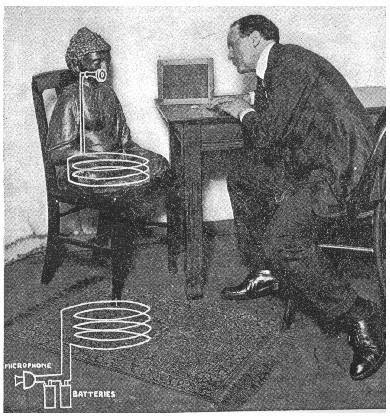
"...the first application of the principles of radio to spiritualistic manifestations was in 1852, when Jonathan Koons, a farmer of Dover Village, Ohio, installed a “spirit machine”—described as a “crude structure of zinc and copper for localizing and collecting the magnetic aura.” But in the magician’s detailed account of this ancient trick he tells us that the apparatus consisted merely of hidden speaking-tubes that led to a confederate in the next room, known as the “invisible girl."It's an interesting theory, anyway, and one that Houdini himself was able to aptly demonstrate. But as we've come to expect from Houdini's séance-busting efforts, the means are overly-elaborate, and a reflection of the magician's reliance on mechanical means to produce manifestations. Houdini must not have known that the spirit room was not located in the proximity of the Koons' farmhouse, and was a simple freestanding, dirt-floored log cabin routinely inspected by hundreds if not thousands. And he likely didn't research the accounts of the crowds that often assembled around the room during seance sessions, hampering any chance of an outside confederate. No, as is usual for Houdini and his other like him--as much as I love them the whole motley crew--the magician resorts to grand mechanical theories to explain relatively simple psychical phenomena, and fails to account for the skills of a talented medium in a dark room filled with believers. But it's an act I'd most certainly like to experience.
Thursday, November 20, 2014
The Invisible Girl: Houdini Evaluates Koons, 1922
Koons' "Spiritual Machine." It appears Houdini weighed in on the table's true
purpose--though generations later and wholly incorrectly--when he
claimed in the October 21, 1922 Literary Digest
that Koons' table was merely an elaborate transmitter for a hidden
accomplice, which demonstrates his failed understanding of the reported
phenomena, more than anything:
Thursday, October 30, 2014
The Mysterious Planchette in the Papers
It's been a busy Halloween season here at Mysterious Planchette. We had the pleasure of filming with Ronni Thomas' Midnight Archive series last month. Ever-amazing, I am absolutely thrilled at the prospect of seeing my collection documented by this amazing filmmaker. Though not yet out, the trailer is below for your enjoyment.
Then there's the latest issue of the SPR's Paranormal Review. I wrote the lead story for this issue, which deals with the important topic of preserving archives and artifacts in the spiritual and occult disciplines, and features articles from the attendees of this summer's "Preserving the Historical Collections of Parapsychology" conference in Utrecht. I hope you'll enjoy my contribution: "Ghosts in the Machines." Thank you to Dr. Leo Ruickbie for having me on board!. You can head over here and see what you can do about getting yourself a copy.
Another article--oddly enough with the same great title--was just released online by Collector's Weekly, and can be found here. It features the fruits of an incredible 2-hour interview I had with the author, Lisa Hix, and has quite a few device shots from the Mysterious Planchette archives. Do check it out!
Stay tuned, true believers. The madness never ends!
Then there's the latest issue of the SPR's Paranormal Review. I wrote the lead story for this issue, which deals with the important topic of preserving archives and artifacts in the spiritual and occult disciplines, and features articles from the attendees of this summer's "Preserving the Historical Collections of Parapsychology" conference in Utrecht. I hope you'll enjoy my contribution: "Ghosts in the Machines." Thank you to Dr. Leo Ruickbie for having me on board!. You can head over here and see what you can do about getting yourself a copy.
![]() |
| Click here to get your copy! |
![]() | |
| Click here to read! |
Tuesday, September 9, 2014
More Bang for My Buck: The Bangs Williams Restoration
![]() |
| A beautiful and complete box for the N. Bangs Williams Insulate Planchette from Michael McDowell's "Death Collection" housed at Northwestern University. |
If you are familiar with my site, you should already know the Bangs Williams "Insulated Planchette." Besides the colorful character that produced it, it is one of the more elegant and unusual products of the First Great Craze, and went through several variations. There's what appears to be a standard model (at least, more commonly encountered model)--unadorned back, label underneath, and intricately-cast apertures and castors, which come in either single-post or double-post wheel housings. The "insulated" moniker comes from the sleeve of bright red rubber nestled between the castor and the plank, to insulate the wood, of course, presumably for purposed of channeling vital energy and animal magnetism. There's also a more rare variant, which includes a couple of cast metal tubes on the planchette's topside, possibly for further "insulation." Regardless of model, the shield-shaped device is well-constructed and really an incredible relic in its own right.
![]() |
| The Burgum-Vespia N. Bangs Williams Insulated Planchette in its unrestored state, from the Hodge Collection. Note the broken posts and missing upper wheel housings. |
I acquired the planchette from my good friend Andrew Vespia. Andrew and I go way back, and our meeting as fellow talking board enthusiasts and our subsequent bonding with Bob Murch helped spark a collaboration and unprecedented cooperation among collectors that persists to this day, and for that I will always be eternally grateful. It was, in fact, at a reunion of the 3 of us last year at Andrew's Houston home that we made the long-overdue trade, and I brought the Burgum planchette home to nest. Thank you, Andrew!
![]() |
| Another Bangs Williams planchette variation with tubes that act either as insulators or to charge Odic force. |
I already knew the Bangs Williams was rare. Andrew's was one of a few I had allowed to slip through my fingers at auction over the years before I got more serious about things, and, of course, the minute I got serious about acquiring one for my own, they stopped appearing. So, I had to be content with visiting Andrew's in Houston a few times a year for a while there. Knowing it would one day need a restoration in any case, I made notes of where those others might have wound up on the off chance I would have an opportunity to perhaps take a casting of the upper wheel housing so I might restore it on the chance I acquired it.
One possible source was the Strong Museum of Play, which houses one Bangs Williams. And, as luck would have it, Murch took a research trip there last year to document their catalog holdings. But as good of pals as we are, asking him to cast a mold in the middle of an important research trip wasn't reasonable, and I wasn't able to join him there as I usually do. I got lots of incredible photographs, though, and was able to note a few manufacturing differences (different label print, metal wheels) thanks to Murch's efforts. Thanks, Bob!
![]() |
| The Bangs Williams planchette, with box, from Michael McDowell's "Death Collection" housed at Northwestern University. |
Within a week of the discovery, I planned the trip for the following month. Once on the ground there, I spent the first day taking over 1,500 photographs of the collection's Spiritualism contents--primarily an amazing trove of spirit photography we'll soon be debuting on IAPSOP.com for research and comparative purposes. After the photographs were done, I started begging the amazingly accommodating curators--Benn and Scott--to allow me to take a mold of their specimen's wheel housing. Their preservationists were away at a conference, however, and an answer would have to wait until the following morning. So with dwindling hours on my second and final day there, I showed up to fantastic news--they would let me take the mold I needed!
![]() |
| The goal! Would it be possible to take an exact mold of this wheel housing without disassembling it and restore the Burgum-Vespia specimen to its former glory? |
![]() |
| Taking the mold! Some index cards help me keep the apparatus balanced as each half of the compound was applied, creating a two-part mold, half of which can be seen, right. |
![]() |
| Casting the housing! Works in progress with drying molds, left. Center: a few attempts before and after cleanup. Right: a fresh casting right out of the mold! |
Which brings up an important note. When undergoing restorations that are anything more intrusive than repairing separated veneer, my first consideration, always paramount, is to not modify the original device in any way just to make it work. It was the same consideration I took in restoring Haffner's Wanda Tipping Table last year, and this non-intrusive philosophy of restoration was the topic of my lecture to archivists at my Preserving the Historical Collections of Parapsychology conference in Utrecht. It's a simple philosophy: if you can't restore an item in such a way that it can quickly and easily be restored to its original, pre-restoration state, then simply don't do it. And that's the approach here--the goal was to have a set of replacement wheels and housings for display, that could be easily removed to restore the item to its original state--exactly like museum dinosaur skeletons have replacement bones to show complete specimens.
Mounting the wheels to the wheel housings was a fairly easy affair as well. From the same frame where I'd harvested the wood, I gathered up a couple of slim mounting nails that had the perfect diameter and patina to match the original axles of the McDowell planchette. I used press-fitting again, snipping them off at just the right length, and the entire unit just came together so quickly once I had all the components that I forgot to stop and take pictures for posterity until I was done!
| The restoration COMPLETE! |
Tuesday, September 2, 2014
The Ghosts in the Machine: Koons' "Spirit Machine"
My research into Jonathan Koons and his family's "spirit room" has brought me down some unexpected avenues, including making some fantastic new friends that just-so-happen to be the direct descendants of Jonathan Koons. Beyond a brief blog post on a curious observation made during some deep research, I've posted surprisingly few accounts of my research work on Koons. I've fallen so far down the well, from formulating a 15,000-word spirit room timeline document, to mapping out the historical boundaries of the Koons farm, to locating Jonathan's fiddle and the precious family photographs of the major personages in the flesh (even handling an original letter written by Nahum!), that it has all just seemed too much to break down into little posts along the way. There'll be a big payoff, for sure, particularly in my spirit communication device book, but for now the file just keeps bigger and bigger, until I'll probably wind assimilating it all in a comprehensive biography or something. We'll see.
I'd very much like my work to correct the sensational blog posts and seasonal news stories that are great about cherry-picking some of the more exciting (and often exaggerated) bits, but fail to recognize just how important the Koons manifestations were in the birth of a new phase of Spiritualism--one that is at once the dawn of a new era, and at the same time the first knell of the death-bell that will signal Spiritualism's great downfall as a major power some decades later. At the very least, the Koons family is finally beginning to get its due, thanks to the work of some enterprising occult historians who I'm proud to associate with (that's Marc Demarest there, along with Lis Warwood, but we've also got John Buescher and Pat Deveney in the mix here), so here's hoping that a decade from now, the formative influences of Jonathan, Nahum, Abigail, and the rest (and let's not forget their neighbors and collaborators, the Tippie family) get the proper historical recognition they deserve.
But here, if I stick to my roots, I tell myself, and focus on the artifacts that sparked your interest, I'll be OK revealing a little here without opening a too-big can of worms and feeling I have to write a new post for every new discovery, because there's a lot going on, and not all of it ready for the public just yet. But let's do that. Let's talk devices. Let's finally talk Koons' "Spiritual Machine."
![]() |
| Koons' Spiritual Machine, as first illustrated in the November 4, 1854 Cleveland Plain Dealer. |
...at length there was a promise extended to me through the mediumship of my eldest son, (aged sixteen years) [MP: Nahum Ward Koons] that if I would construct a table according to a draft drawn by the spirits through my son as the medium, and place it in a private room for their own use, that then I should have incontrovertible evidence of the existence of spirits, to which I immediately acceded, and the same was built and placed in a private room, and furnished with paper and pencils, as requested through medium agency, when the spirits commenced writing without any medium agency whatever, in said room; which fact removed every lingering doubt from my mind, for the room was kept constantly closed against the entrance of my own family, or any other person during the time the writing was performed.In another credit-where-credit-due moment here, we see it was the "spiritual machine" itself that was instrumental to the manifestations of the spirits on the Koons farm, with their famed spirit room--which gets all the fanfare, really--merely meant to house the artifact. Thanks to the machine--as Emma Hardinge Britten put it--"collecting and focalizing the magnetic aura used in the manifestations," an amazing array of previously unheard-of phenomena took place: dark séances, a cacophony of spiritual music played on a small orchestra of floating instruments, spirit writing, luminous spectres and ghostly appendages glowing in the soft light of phosphorous, and mysterious whispers of the spirit "King" issuing forth from Nahum's tin trumpet. Phenomena all, as my colleague Mr. Demarest recently stated, "at least as important for the subsequent history of the Spiritualist movement as the Fox Sisters."
So what was the machine responsible for all of this? We are incredibly fortunate that the Cleveland Plain Dealer (and also Spiritual Universe) took the reports seriously enough to feature the machine in their November 4, 1854 edition, which was subsequently reprinted in part in the February 3, 1855 edition of Scientific American. Others documented some of its finer points as well, including the Anglo-American Magazine, so let's look at it piece by piece according to some of these sources and see exactly what's going on in this illustration.
According to the Plain Dealer [PD], which provided the original number-coded illustration, the base of the "queer piece of mechanism" was a six-legged table "about six feet long by two and a half feet high. The table and the wood portion of the machinery is cherry, which is stained and varnished." The Anglo-American [AA], in an article authored by E.V. Wilson, noted the top was "30 inches wide, supported by six legs, in it are four drawers (GG) which contain nothing save a few dishes of paint, brushes, pencils, charts, &c., for the use of the spirits..."
Resting on the tabletop was a 4-foot high wooden framework (22) supported by an upright post topped with an ornate glass knob (A). This framework consisted of either two or four curved wooden pieces that, as Wilson described, were "somewhat in the shape of the letter f." Attached to the outside of this frame were two important components: drums--a larger bass (C) and a smaller tenor (B)--"firmly secured to the machinery and to the table by wires"[PD]. The spirits would beat mightily on these drums to announce their arrival to the room, or play them "in a masterly manner" [AA] to accompany Jonathan's fiddle playing, and are frequently mentioned in descriptions of the spirits' materializations in the room.
As described by the Cleveland Plain Dealer, three rods or bars ran parallel to the tabletop, with various ornamentation of glass knobs, small bells, and wires. On the topside there was a lower "steel bar about half an inch square"(EE) and an upper "bar of wood with three glass knobs attached wound with wire and ending with a scroll"(44) that rested on the lower steel bar. Below the table, there was "an eight-sided wooden bar suspended under the table by copper wires, with a number of wires running the whole length of the bar"(HH).
The "copper wires wrapped with zinc" are extremely important to the spirit machine's construction, and not just to bind the whole thing together. The wires were "woven into a kind of net work with copper and tin plates," that served as a sort of battery to facilitate the spirits' design of their "electrical machine." The table, at its core, was exactly that, designed by the spirits "for collecting and retaining electricity" so that through this energy they might manifest in the charged confines of the spirit room.
The alternating tin and copper plates would, in theory, constitute a basic voltaic pile, even if it was missing the electrolyte component. There were several such stacks: "double plates of tin and copper" (33) located close to the table's center where the upper steel and wood bars converged; the much larger "double plates, fastened together, one plate of copper the other of tin" (DD) that seemed to be either hanging from the frame or supported by the steel bar's scrollwork; and the smaller copies nestled at the corners where the framework met the table, described again as "double plates of copper and tin attached to the wires" (FF).
The appearance or configuration of these copper plates are hard to realize in two dimensions. Some clues may come from the “celebrated medium from Nashville, Tennessee,” Mr. H.B. Champion, who described the table after a September 1855 visit to the room:
“The two drums are fastened with copper wires upon wooden supporters at the top of the table. This table is intersected with copper wires wrapped with zinc. On the upper cross wire hang some copper plates, cut in the form of doves, to which are suspended a number of small bells, which the spirits sometimes ring.” [MP: emphasis mine]This description may explain the strange shape of the "plates" in the Plain Dealer illustration, though there they were described as "leg-of-mutton tin and copper plates," so that inconsistency is puzzling, given that the latter description hints the plates took the form of simple oval, raised-rim dinner plates, even if the illustration does not depict them as such, and appear more dove-like in shape.
![]() |
| The fully annotated illustration of Koons' "Spiritual Machine" from the more clear Scientific American illustration. |
Of course, that last bit there's pretty darned important, too, but more on that later.
There are a few other interesting tidbits to mention as well. Though Jonathan Koons was clearly the spiritual machine's creator, his neighbor and collaborator, John Tippie, had an identical table-machine housed in an identical room, just 3 or so miles away over a rough country road, and many early accounts of visitors show that both rooms were equally popular, with guests frequently swapping back and forth between the rather poor accommodations to experience similar manifestations, music, and messages (indeed, from the same spirits) in the Tippie Rooms that they'd experienced in Koons'. So there were two of these amazing machines.
But the efforts of the Koons family did produce entirely new categories of phenomenon, even if "spirit machines" didn't start popping up all over the country the way spirit rooms emulating Koons' did. Nahum's trumpet mediumship birthed an entirely new mode of mediumship, for instance. All over the country, the lights started going out in séance rooms, signaling the slow decline of the first-generation rappers and heralding the new vanguard of manifesting mediums in the vein of Florence Cook and Eusapia Palladino. New words will eventually spring up to describe the forces responsible: Teleplasm. Ectoplasm. Mumler and others will begin claiming they can capture materialized spirits on film by the early 1860s, and growing rich in the trade of spirit photography. It goes on and on, until mediums trying to satisfying the insatiable need for physical phenomenon first sparked by Koons are getting caught by the glare of smuggled flashlights or manhandled by skeptics prancing around the séance chamber in their muslin robes, signaling an increasing schism within the movement it will not well endure.
The waterways of Koons' influence snake their way into so many classes of spiritualistic phenomena--many of which are simply so commonplace and "trope-y" in our modern era that we take their origins for granted now--that it can be difficult to trace it all back to the headwaters. But the efforts of that family in podunk Ohio in the early 1850s produced both trickling streams and rising floodwaters, all of which I'm thrilled to navigate.
So, there's our physical examination of the Koons device. In future installments, we'll more properly discuss the phenomena for which the spiritual machine was responsible, follow the breadcrumbs back to Nahum's nascent spirit trumpet mediumship, examine the Koons' lingering effects on the Modern American Spiritualism and their contributions to its decline, and, God-willing, even explore the site itself. Godspeed!
Monday, August 25, 2014
Brussels Artifacts: Christian Chelman's Surnateum
In 1996 I left my small hometown and moved to Austin to gain my degrees from the University of Texas, and began working at a small shop called Lone Star Illusions--previously a hologram store that had morphed into an eclectic gift shop. There was a magic counter there, and as the new guy, I was assigned to learn all manner of cheap red-plastic S.S. Adams tricks to perform to cajole customers into buying them. I embraced it, and before long was in charge of ordering better quality stuff, and getting better as a magician while performing to larger and larger crowds in the shop, where the small magic counter started to dominate sales. It was pretty neat.
But I soon discovered and embraced another form of magic, what I've always called the red-headed stepchild of the magic community: bizarre magic. Heralded by godfathers like Tony Andruzzi, Eugene Burger, Charles Cameron, and Doc Shiels, bizarre magic focused less on 'watch me trick you' and more on 'let me tell you a story,' which were invariably darkly and almost always occult-themed, with surprise twists and subtle magic effects that just synthesized all the life influences I had had up to that point and focused them into an intense interest in further explorations of occult history.
I quickly discovered Eugene Burger's Spirit Theater. Scott Davis' Séance magazine (both available from my friends at www.hocus-pocus.com). There were Mary Tomich's amazing Thaumysta Magic Company effects. And Steve Bryant's great Little Egypt Gazette. But the English translation of Christian Chelman's Capricornian Tales was it for me, synthesizing the storytelling aspects of bizarre magic with genuine antique artifacts in a way that played to my own antiquarian aspirations and the types of resonance I wanted with audiences. It changed everything. Before too long, I was corresponding with Christian and other practitioners and deep into developing new routines with some of the antiques that were quickly piling up in my small flat. And I acquired my first old, worn Ouija and Selchow & Righter 'Scientific Planchette' in a then-new marketplace called eBay, for use in effects for my séance-inspired show of haunted antiques.
It's been a fair number of years since I retired the haunted antiques show, stopped practicing my Elmsley Count and Ascanio Spread, and left performance behind me. But the love of old, resonating objects and the desire to accumulate them--a trait inherited from my father--took hold, and my collection--particularly of planchettes--grew over the years. Which is what brings us here, isn't it?
So, all these years later, with the opportunity to again call upon my old friend after many fallow years, I took a train to Brussels at the close of the conference in Utrecht, and made my way through the haunted streets and ethereal alleyways there to Mr. Chelman's immaculately curated Surnatéum: The Museum of Supernatural History.
The draw was the unique set of artifacts in the museum's holdings. The profuse number of sacred and profane objects on display the Surnatéum would take many more blogs to cover than I am capable of producing, and many of the more important artifacts are on display in the digital galleries. No, what drew me to Christian after all of these years was something very special indeed.
We've talked about the earliest origins of table-tipping here before. It's something that my colleague Marc Demarest and I have been mapping out for some time now. The summer of 1853 was when the phenomenon hit France, and after a brief flare of popularity in the 'everybody's doing it' vein, the tables tournantes returned underground to a set of specialized enthusiasts. And we think from that body, this incredible item may have emerged.
Discovered first in a Parisian flea market then brought to Brussels by a dealer familiar with Mr. Chelman's esoteric interests, the table appears quite old, and custom-crafted as it stands--it is most certainly not a piece of ordinary furniture modified for spiritual use. It stands just under 32-inches in height and is carved of oak. The top rotates freely and comes off with a gentle tug. Christian notes that the central column is carved in the likeness of an Acanthus leaf, which symbolizes immortality via death and rebirth--an important Spiritist doctrine. While the top appears at first to be some leather overlay, it is actually an intricately-carved lace pattern on a solid piece of oak. The three small insets contain the words "Spiritisme," "Christ," and "Moïse," (representing a trinity of Spiritism, Christianity, and Judaism) and the 3 columns contain a letters and numbers correspondence system with a lowercase alphabet. The first column, for example, reads: "a-1, b-2, c-3, d-4, e-5, f-6, g-7, h-8, i-9." Curiously, the continuing alphabet on the other two columns restart the number sequence at "1," and run 1-9 for j-r and 1-8 for r-z. We'll get back to that momentarily.
The table may be a variation of what Kardec termed a "Table Girardin" in his 1861 Le Livre des Mediums, describing a type of alphabet-engraved turning table employed by the medium Madame Emile be Girardin:
Mr. Chelman's table has many--nay, most--of these characteristics: it turns freely on its axis and contains the alphabet, though not arranged as a dial. From previous investigations of pictures of the table, I had expected the top to contain a central housing for a missing needle or index, but after seeing it in person, it is obvious that isn't how it was designed to be used--the central inset that looks deep in photographs is just a shallow lathe depression. And in any case, the alphabet columns do not lend themselves to proper pointing by an index--the letters would need to be arranged dial-like, as on a true Table Girardin, rather than stacked as they are.
So what to make of its use? Christian has long theorized that the table would be used in conjunction with alphabet-calling or spirit rapping, with the table turning autonomously to the proper column, and raps indicating by number which letter the spirits wished to choose. It's certainly the most reasonable possibility, if a touch convoluted, particularly compared to normal alphabet calling, as it hardly seems a more expedient method to arrive at communications. Mr. Demarest has some theories of his own that I'll try to persuade him to post, revolving mostly around the lack of a "0" binary and the resulting problem that the table can't actually signal any numbers without spelling them out, since numbers equal letters on this table. But I can't think of any other way it might be used.
Christian--who is a well-versed Spiritualism historian, mind you--has an interesting theory: one born of the mind of a true magician. The spindle and central housing for the table's top has a recess--a significant gap between the spindle's resting point and the tabletop. Christian believes this may have once allowed a small horistonotus uhlerii--a click beetle--to be secreted away there on its back to continuously produce the necessary raps. Since the upside-down beetle wouldn't be able to right itself without enough distance to flip, chances are it would keep trying and keep clicking, which is what the ones that sneak into my house do on our wooden floor. It's an interesting theory, and while there's no evidence I have seen that such beetles were ever exposed as the cause of spirit rappings, and there's no way to control those raps to ensure a comprehensible communique, it is an intriguing suggestion.
Another deduction by the Surnatéum's curator is why I think Christian is singularly-qualified to be this artifact's caretaker. Christian spotted a series of deep, smooth grooves in the tabletop's underside. See the picture below. We know that fraudulent table-lifting was often accomplished through the use of wrist-strap contraptions or hooks used to leverage the table while the medium or magician kept their hands on the tabletop, fingers outstretched and seemingly free from undue influence. While such contraptions were typically reserved for larger and more imposing furniture that seems by its sheer bulk to be too large to lift independently, it could have presented an incredible climax to a séance if the evidence means the table was indeed used in this manner. But there's also the problem with the table's top popping off fairly easily, and hardly being heavy enough to impose the pressure to wear down such grooves, so it may be damage totally unrelated to that idea. There's just no way of knowing.
The opportunity to have this table in my hands is something I have looked forward to for a very long time. It has so many fascinating aspects, and poses as many questions as it answers. It's true age is anyone's guess, as are its origins, though it is undoubtedly French. It could date as far back to the early 1850s, or sometime well past the turn of the century. To wager an educated guess, however, and given the vogues of spirit communication in France (and the downturn of rapping as a communication medium), the 1850s-1880s is the most likely span of dates for the table's construction. If it is what we believe it is, it is just a singularly incredible artifact, and, to me, the cornerstone of the Surnatéum's holdings.
The tour of the Surnatéum's archives was far from over for me, however. The collection and library is incredibly vast, and covers multiple stories. Within, I beheld one of the most amazing and convincing fiji mermaids I have ever seen, and one of the world's very few genuine vampire-killing kits. In fact, Christian's collection of first-edition vampire lore may be one of the most extensive privately-held collections. There's an entire wing of native fetishes and fortune-telling devices from several continents. I could have persisted there, like a stubborn thorn, for days. But with only a few spare hours, I trained my eye on the remaining spirit-related devices.
The pictures will mostly speak for themselves. Christian owns a number of glass slides similar to my own, which portray spirit photography or scenes of ectoplasm production and séances in progress. The collection also contains an ingenious set of small slides complete with a portable viewer, with film slides featuring the trumpet and physical mediumship of Leonard Stott, among others.
There was an entire folder of automatic writing and seance reports, some Spiritualism-and-fortune-telling-based games from Europe, and a ghost-hunting kit from a Belgium reporter who indulged in psychical research. A complete early Fuld Ouija on a high shelf as well.
There were at least two specimens of rapping hands, the Thayer specimen complete with a Victorian mourning ring.
And, last but not least, and sure to thrill readers who are also talking board fans, there's an amazing hand-crafted "Oui-Ja" board out of France. It is a massive specimen that could easily be a tabletop, and in fact could be made from one. The planchette is a beauty, mounted with a carved skull. The piece has a matching end table that holds the planchette, which seems an intentional companion piece. Another flea market find, nothing else is known about the item, though Christian believes it is post-war.
I could continue with the Curator's array of first edition Spiritualist texts, the massive library of esoterica magica, the room full of African tribal fetishes and sap oracles, the strange biological specimens, and the massive assemblage of occult items, but I'll leave you free to explore to the mysterious and mist-shrouded halls of the Surnatéum's digital incarnation.
I want to thank Christian not only for his long friendship and correspondences which I have not maintained as well as I should, but also his fellowship and hospitality. I can honestly say that without both his work in magic and the occult, and his guidance through my long-gone days as a young bizarrist, my interests would not have been so severely cultivated, and I likely would not be here talking about esoteric topics to the wide audience I've achieved. A million times, "Thank You." Una lingua numquam satis est!
I can think of no better coda to close this series recounting my European tour. We'll return to our regular smorgasbord of posts shortly.
But I soon discovered and embraced another form of magic, what I've always called the red-headed stepchild of the magic community: bizarre magic. Heralded by godfathers like Tony Andruzzi, Eugene Burger, Charles Cameron, and Doc Shiels, bizarre magic focused less on 'watch me trick you' and more on 'let me tell you a story,' which were invariably darkly and almost always occult-themed, with surprise twists and subtle magic effects that just synthesized all the life influences I had had up to that point and focused them into an intense interest in further explorations of occult history.
| Surnatéum's incomparable curator, Christian Chelman. |
| Earliest origins, circa 1997. |
So, all these years later, with the opportunity to again call upon my old friend after many fallow years, I took a train to Brussels at the close of the conference in Utrecht, and made my way through the haunted streets and ethereal alleyways there to Mr. Chelman's immaculately curated Surnatéum: The Museum of Supernatural History.
| But one wing of the remarkable Surnatéum. |
We've talked about the earliest origins of table-tipping here before. It's something that my colleague Marc Demarest and I have been mapping out for some time now. The summer of 1853 was when the phenomenon hit France, and after a brief flare of popularity in the 'everybody's doing it' vein, the tables tournantes returned underground to a set of specialized enthusiasts. And we think from that body, this incredible item may have emerged.
The table may be a variation of what Kardec termed a "Table Girardin" in his 1861 Le Livre des Mediums, describing a type of alphabet-engraved turning table employed by the medium Madame Emile be Girardin:
"This instrument consists of an upper movable stand, of from thirty to forty centimetres in diameter, turning freely and easily on its axis, in the manner of a roulette. On the surface, and at the circumference, are traced, as on a dial, letters, figures, and the words yes and no. In the centre is a fixed needle. The medium resting his fingers on the edge of the table, this turns and stops when the desired letter is under the needle. Notice is taken of the letters indicated, and thus words and phrases are rapidly formed. It must be remarked that the table does not slide under the fingers, but the fingers, remaining on it, follow the movements of the table."
![]() |
| The medium Madame E. Le Roux at play at the tables tournantes, 1909. Note ghostly face over shoulder. |
![]() | |
| The alphabet system has long since lost any highlights that would make the letters readable. To capture them, we resorted to corn starch to fill them in for documentation. |
Christian--who is a well-versed Spiritualism historian, mind you--has an interesting theory: one born of the mind of a true magician. The spindle and central housing for the table's top has a recess--a significant gap between the spindle's resting point and the tabletop. Christian believes this may have once allowed a small horistonotus uhlerii--a click beetle--to be secreted away there on its back to continuously produce the necessary raps. Since the upside-down beetle wouldn't be able to right itself without enough distance to flip, chances are it would keep trying and keep clicking, which is what the ones that sneak into my house do on our wooden floor. It's an interesting theory, and while there's no evidence I have seen that such beetles were ever exposed as the cause of spirit rappings, and there's no way to control those raps to ensure a comprehensible communique, it is an intriguing suggestion.
![]() |
| Might this recess once have housed a click beetle to produce mysterious rappings? |
![]() |
| The mysterious worn grooves on the table's underside. Lower right, Dunninger displays table-lifting apparatus that may be responsible. |
![]() |
| The Surnatéum's fabled curator holds his prize. |
The pictures will mostly speak for themselves. Christian owns a number of glass slides similar to my own, which portray spirit photography or scenes of ectoplasm production and séances in progress. The collection also contains an ingenious set of small slides complete with a portable viewer, with film slides featuring the trumpet and physical mediumship of Leonard Stott, among others.
There were at least two specimens of rapping hands, the Thayer specimen complete with a Victorian mourning ring.
And, last but not least, and sure to thrill readers who are also talking board fans, there's an amazing hand-crafted "Oui-Ja" board out of France. It is a massive specimen that could easily be a tabletop, and in fact could be made from one. The planchette is a beauty, mounted with a carved skull. The piece has a matching end table that holds the planchette, which seems an intentional companion piece. Another flea market find, nothing else is known about the item, though Christian believes it is post-war.
I could continue with the Curator's array of first edition Spiritualist texts, the massive library of esoterica magica, the room full of African tribal fetishes and sap oracles, the strange biological specimens, and the massive assemblage of occult items, but I'll leave you free to explore to the mysterious and mist-shrouded halls of the Surnatéum's digital incarnation.
I want to thank Christian not only for his long friendship and correspondences which I have not maintained as well as I should, but also his fellowship and hospitality. I can honestly say that without both his work in magic and the occult, and his guidance through my long-gone days as a young bizarrist, my interests would not have been so severely cultivated, and I likely would not be here talking about esoteric topics to the wide audience I've achieved. A million times, "Thank You." Una lingua numquam satis est!
I can think of no better coda to close this series recounting my European tour. We'll return to our regular smorgasbord of posts shortly.
Monday, August 11, 2014
Utrecht Artifacts, Part 2: Slates, Ghost Lamps & Miscellany
Continuing where I left off from Utrecht in Part One, we now arrive at the Harmonia/Beelmaterial Spiritische Museum's array of spirit slates, spirit paintings, and ghost call-bells. With the gap between blogs posts as I find time to write, more and more distance comes between now and the European tour itself. It was such a whirlwind I had little time to digest it while there, but now, looking back, it becomes more and more amazing with each recollection, from the acquaintances made to the artifacts I was able to handle and document. And I am thrilled to see that my peers were equally impressed by the experience, as well as with my lecture, "Preserving the Physical Artifacts of Psychical Research."
Leslie Price had some kind words for me in the latest issue (August 2014) of Psychic News, judging my lecture "one of the most remarkable" of the conference. And he makes a further challenge to readers that I encourage them to take up: "In listening to this [Brandon's lecture], I thought of the hundreds of Spiritualist churches which may have such equipment, perhaps lying forgotten in cupboards. By means of photography and the internet it’s now possible to get these appraised by Brandon Hodge, who is making an international survey of such devices." Such opportunities are one of the great joys of this self-appointed task, and I would love nothing more than for the difficult job to become all the easier, with such institutions soliciting my aid, rather than me having to seek them out. Do contact me with questions about any and all items you may discover at your various churches and archives.
Tom Ruffles gives us a similar review of the conference with a daily breakdown on his blog, and I encourage you to read it in its entirety. He discusses not only my representation of IAPSOP, but also my preservation lecture, and gives a very nice summary of its main points. Similar overviews are given for the other lectures at the conference, all of which were incredibly informative. Do give it a read.
But what of the remaining Utrecht items? There are many, actually. Far too many to cover here, and far too many for me to even document in their entirety while in Utrecht. Fortunately, Wim and his compatriots have done an outstanding job of that on their own, and I was able to concentrate on those spirit communication items most of interest to me for my upcoming book.
![]() |
| Ghost lamp featured in the May 1936 edition of Spiritische Bladen. |
I think the single most astounding artifact in the collection is the surviving ghost lamp. The purpose of ghost lamps were two-fold. Such contraptions signaled the arrival or presence of spirits so that séances could begin, and it could serve in the same capacity as spirit raps or modern flashlight séances by blinking on and off to indicate positive and negative responses, or even respond to alphabet-calling.
![]() |
| Lamp switch detail. |
Ghost lamps and call-bells gained some traction among Dutch Spiritualists during the 1930s. The Dutch periodical Spiritische Bladen published an article on their use and construction in its May, 1936 edition, which my lovely friend and amazing science photographer Loes Modderman was kind enough to translate for me. At its heart, the device is little more than a battery-operated bulb and a simple switch that takes the form of an easily-manipulated balance or scale, so that a slight tip one way or the other of the scale's balanced arms causes the switch to engage and the light to briefly flash. In this way, it was designed so that spirits with enough ectoplasmic fortitude could manipulate the device to signal their arrival, tipping the switch with a ghostly appendage so the bright light of the lamp flashed out into the darkened séance chamber to let the sitters know they were ready to communicate. That seems the only illustrated purpose of the device, but Wim informs me of other accounts where communication indeed took place on the alphabet-calling model.
The crudely-constructed device shown in the how-to illustrations in the Spiritische Bladen pales in comparison, however, to the artifact I was able to document. It is not the most astounding piece of carpentry, but it is obvious that great care and consideration was taken in its construction. The carved and trimmed wood box is dark-stained, and measures approximately 8-inches across and 6-inches high. The ghostlamp went through at least two evolutionary forms in its long life: first constructed to house a battery in its frame, it was modified at some point in its history and wired for electric power.
Two circular brass plates and a crooked connector serve as the balanced switch, which tips to either side with the slightest breeze to activate the small lamp. It is so sensitive, in fact, that it may go a long way in explaining why there's a loop for wall-installation on the back of the device--obviously constructed for tabletop use, it may be that the slightest nudge of the table tipped the scale and triggered the light, and its creators saw fit to hang it nearby on the wall to escape undue influence on its operation.
We discussed plugging it in and giving it a go, but were worried we might inadvertently spark an electrical fire, so we resisted the temptation and let the historical object lie.
Another closely-related object--though much more crude, and a much less old--is the collection's call-bell. Its use would be nearly identical to the ghostlamp, only providing a ring to signal the spirit's desire to communicate, rather than the flashing light. This device's origins or how the more modern piece came to be included in the collection are unknown, but there's some question if the device even works as one supposes--there is no switch wire or balance, and we guessed that plugging it in would either cause it to ring continuously, or to not work at all. It may be that it was never finished, is missing an integral component, or it was simply an early attempt by an inexperienced enthusiast. It's still a lovely inclusion to the collection!
The Harmonia archive holds several important spirit slates, many of them with preserved messages intact. There are more than pictured, but were difficult to photograph and document since some have a glossy film tacked over the slate in an effort to prevent the chalk spirit writing from smearing or disappearing. It seemed no matter which angle I attempted to photograph from, I either got a nice reflection of my own head and camera, the glare of lights, or a nice grid from the reflection of ceiling tiles. Such are the challenges of working in the field. I did manage a good shot of one such "direct schrift" slate, however, with a message dating from April 20, 1932:

Another pair of slates is noteworthy for their construction. Unlike most paired slates which are identical in all respects, and usually just regular school-slates used in the period, this pair seems specially-constructed to gather spirit writing. In the picture below, note how the bottom slate is deeper and recessed. The top slate would be bound, lid-like, above the other, and the resulting space left ample room for spirits to manipulate the chalk between the slates. The method isn't novel, and is one of the most common forms of obtaining spirit writing--but the design consideration is. Just a wonderful pair that, while lacking the preserved writing of its companions, shows the time, thought, and consideration that went into the item to foster the belief in what it could accomplish.
Lastly, for just a bit of slightly-off-topic fun, the collection includes a real screen used for Rhine ESP testing. In use, the screen would be stationed between the tester and the tested, and the results shown by sliding aside the wooden slat window. Wim informs me that he has pictures of this very screen in its historical use, so I promise to share those as they become available. Just a lovely artifact that was a lot of fun to examine.
I can't thank my hosts enough for this incredible opportunity to document this amazing collection, and I'm grateful for all the new friends and researchers that attended the conference and opened their minds to other sides of our respective disciplines. Thank you again to Wim, Loes, and all of our lovely hosts for their hospitality and assistance during my stay in Utrecht. Now, onward to Brussels to examine more incredibly important artifacts in the collection of one of the world's most enigmatic magicians!
Subscribe to:
Posts (Atom)


